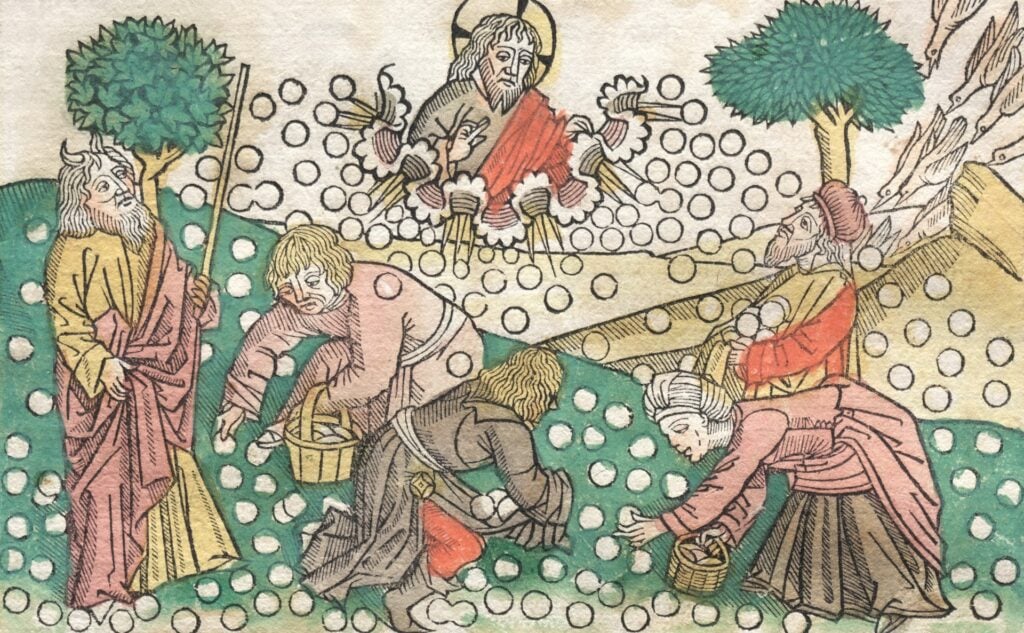
In the wilderness God provided for the material needs of the children of Israel with manna. Every morning the manna appeared on the ground and the Israelites went out to get it with the following instruction: “‘Each one is to gather as much as he needs. Take an omer for each person you have in your tent.’ The Israelites did as they were told: some gathered much, some little. And when they measured it by the omer, he who gathered much did not have too much, and he who gathered little did not have too little” (Exodus 16:16-18).
The text tells us that some individuals were more able gatherers than others (“some gathered much, some little”). But though the manna was gathered unequally, it was distributed equally. Every family got one “omer” for each person in the tent. (Some commentators have believed that the “even-ing out” happened miraculously, but since John Calvin’s time the consensus has been that the Israelites pooled the manna and kept the agreed-upon ration.)
The apostle Paul makes some remarkable inferences from the manna provision. In 2 Corinthians he urges the Corinthian church to give generously to the collection for the poor in Jerusalem (cf. 1 Corinthians 16:1-4; Acts 11:27-30; Galatians 2:1-10). Then he says, “Our desire is not that others might be relieved while you are hard pressed, but that there might be equality. At the present time your plenty will supply what they need, so that in turn their plenty will supply what you need. Then there will be equality, as it is written: ‘He who gathered much did not have too much, and he who gathered little did not have too little’” (2 Corinthians 8:13-15). When Paul quotes Exodus 16:18 he is making a very direct connection between manna and money. What does it mean?
First, Paul means that our money should be seen to be just as much a gift of God’s grace as was the manna. God met the physical-material needs of the Israelites by bringing manna within their reach. So God meets our physical-material needs by bringing financial income within our reach. The Hebrews had to go out and gather the manna daily, and some were better gatherers than others. So we must go out to “earn our daily bread” each day, and some are better moneymakers than others.
The reasons for the disparity between gatherers are complex. One reason you might gather more manna (or money) is because you work harder and faster. But another reason you might gather more is because of abilities (size and speed, or intellectual gifts and so on) that are natural endowments which you did not “earn” but simply received from God. So in the end, what you gather is yours by God’s grace. You could just as easily have been born into circumstances in which all your hard work and gathering would result in poverty and starvation.
Second, Paul means that the money we make beyond our personal needs must be shared and used to build up community. The Exodus/2 Corinthians connection shows that God has this standard in his mind for how we use our money. The money we gather can be spent on and consumed by us only to the extent that it supplies what we really “need.” Beyond that we must share our money to meet the needs of others and strengthen the community.
The Bible will not grant the premise that because you gathered the money you have absolute rights over it—it was the gift of God to us.
But the Bible will not grant the premise that because you gathered the money you have absolute rights over it—it was the gift of God to us. And it is evident from Exodus 16 that God has in his mind this standard whether we do or not: we are not to spend money on ourselves beyond our basic needs for a safe, healthy life. Paul not only applies this principle of manna to money in 2 Corinthians 8:15, but in 1 Timothy 6:6-10 he tells us to “be content with food and clothing.”

This cannot mean that all Christians are to live at subsistence level. There are too many rich persons (Abraham, Job, Philemon) who are not called to divest themselves of their wealth. There should be Christian communities within every human community—including affluent ones.
What this means is that we are obligated to keep our living costs down, to seek to live at the “lower end” of the bracket of our particular socio-economic community, and to give away all the income we can. Almost certainly what Moses and Paul think of as “basic needs” is lower than the living-standard-expectation of the average professional person in the U.S.
Craig Blomberg is the author of an excellent book called Neither Riches nor Poverty: A Biblical Theology of Possessions (Apollos, 1999). Near the end of the book he shares some personal information. His full-time seminary professor salary and his wife’s half-time secretary salary puts them at $4,000 below the median income of the average household in their relatively affluent Denver suburb. However, they live in one of the “lower end” homes of their particular town. Blomberg says that his family saves, goes out to eat, goes to sport and cultural events, and gives one another gifts pretty much like their neighbors—only they do so with considerably less frequency. As a result of watching their spending in these ways, they have been able to “push the envelope” so that they now give 30% of their annual income away annually. He indicates that no one in his family feels that this is a major hardship—nor a particularly difficult accomplishment.
… he tells us that the needs of others around us must be a major determinant of the magnitude of our giving.
In Paul’s application of the manna-principle in 2 Corinthians, he tells us that the needs of others around us must be a major determinant of the magnitude of our giving. Let me give a rather simple illustration. In the aftermath of September 11th, Redeemer experienced a major influx of new people and faced a huge increase in spiritual, emotional, and material needs. But 9/11 also flattened our economy, putting hundreds of Redeemer people out of work, including a healthy percentage of our leaders and key givers. As a result, while the needs increased enormously, our income lagged far behind. There were more people to care for that year than the previous year, but many of the people who have given over the years to support the ministry cannot do so now. [] [1] God provided over $2,000,000 of unexpected out-of-town gifts which supplied many of those needs.
Manna that was hoarded became “maggoty” and rancid (Exodus 16:20). Would it be true to the biblical metaphor to conclude that money that could be shared but which is kept for yourself will rot your soul? I believe it might.