Recently, I watched The Princess Bride with my kids. Near the end, Inigo Montoya confronts the six-fingered man who murdered his father. He wins the duel he spent his whole life training to fight. But it’s not enough. Holding a sword to his adversary’s face, Inigo says, “Offer me money. Offer me everything I ask for.”
“Anything you want,” the man promises.
Inigo responds, “I want my father back.”
I started to cry. I’ve watched that scene many times before and never felt emotional. But this time, my Dad was gone. He died in 2023. Grief does something strange to you. It exposes the stories you have been living, and then it tests whether any of them hold up when the sadness comes down.
Inigo built his life around one purpose. He knew his lines and his objective. When he achieved his goal, his father was still gone, leaving him with nothing. Most of us run a version of the same play, believing something will finally make us whole: career, relationships, or a better self. We achieve it, only to ask the question no one prepared us for: Now what?
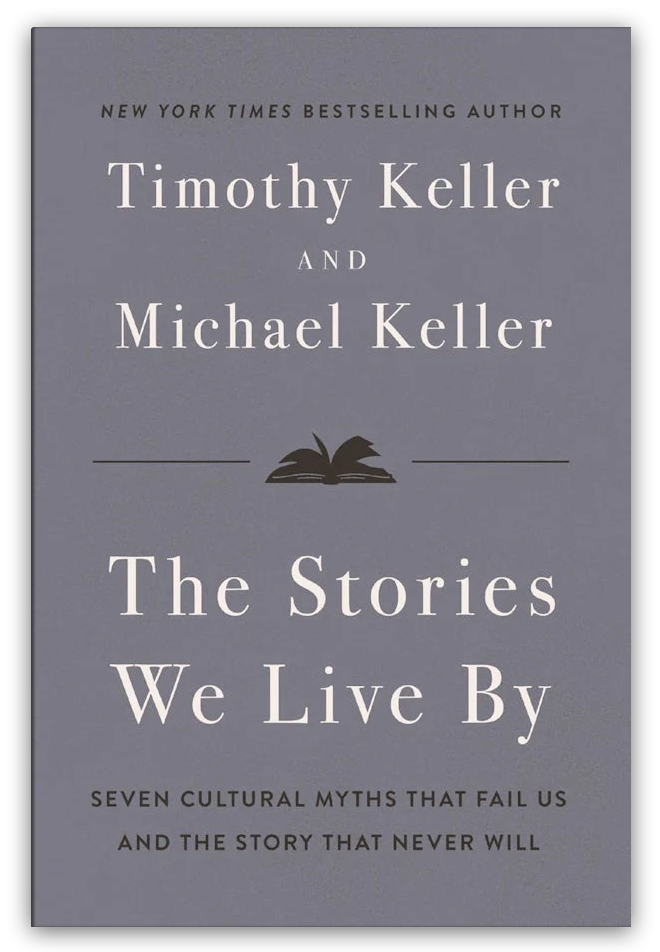
That question is where Dad and I began working together on the book The Stories We Live By. Do your cultural stories satisfy you when you’re standing over an enemy’s body, and your father is still gone?
My father, Tim Keller, had been thinking and writing about these stories for over a decade. They appear in his other books, but only in passing, and not as the main event. This was one of the last books he was working on before he died, and it has turned out to be his final sustained parsing of culture. I was able to draw on hundreds of pages of unpublished notes on these stories, driven by two questions: What are the hidden stories our culture tells us about who we are, and do they actually hold up?
He named seven particular hidden stories our culture tells us.
- Identity
- Freedom
- Happiness
- Power
- Morality
- Truth
- Progress
These are not academic categories or topics. They each have a hero and a villain—something idolized, and something demonized. We don’t consciously think about them, although they are woven into our slogans, songs, and social media feeds, answering life’s biggest questions: What am I doing here? What’s wrong with the world? What will make it right?
You didn’t choose to believe that being true to yourself is the greatest good or that real freedom means no one tells you how to live. You absorbed it like an accent, simply by growing up where you did.
Every culture answers these questions for its people, usually before we even know to ask them. You didn’t choose to believe that being true to yourself is the greatest good or that real freedom means no one tells you how to live. You absorbed it like an accent, simply by growing up where you did.
Dad said these stories are “more caught than taught.” Charles Taylor calls them the “social imaginary,” which are assumptions so deep that other views seem unthinkable. You are the stories you believe. This book brings those stories into the light, so you can look at them, not just through them.
Where The Stories Break Down

The method Dad used was to go through each story and show what we can affirm, critique and redirect.
To affirm, we must first enter the story on its terms. Identify what is good and true, and how it seeks to meet real human longing. Then show where it breaks down and fails to deliver on its promises. Next, retell and redirect the story, showing how the longing beneath is answered more fully and honestly by the gospel than by the story itself.
Take identity. The story is found in mottos like “You do you” and “Follow your heart.” It says to look inward to find your true self, and then have the courage to not let anyone get in the way of who you need to become. Identity is a good thing, and it’s good not to just let other people define who you are. But if identity must be assembled from within and then defended against a world that may not accept it, you are constantly on defense. It means it is all up to you to define, determine, and execute who you are. An internally generated identity does not free us, because we are now bound to the exhausting process of performance dressed up as discovery.
The Christian answer is not that identity doesn’t matter, or that you should give up looking for it. It says you have been looking in the wrong direction. Your identity is something you receive, not something you achieve. You don’t have to build it or guard it. It is given to you by a God who knew you before you ever did anything, and whose love does not change when your performance does. Rooted in his love, your identity cannot be taken away because it is not dependent on the recognition or actions of others.
Identity is the first of seven stories explored. Each story reaches for something worth wanting. The only question is whether the story can actually take you where you hope to go, and what, in the end, can really deliver on that promise.
What the Gospel Claims
Christianity does not walk up to these stories and announce that you were a fool to want what you wanted. We show in the book that what the Christian story claims is much bolder and wondrous. The longing underneath each of these narratives—for a self that is fully known and still loved, for justice that does not devour the people who carry it out, for a joy that does not evaporate the moment you finally hold the thing in your hands—is answered more truly in the gospel than in the story that first stirred the longing. That longing is not replaced by something foreign to it. It’s completed by the very thing it was always straining toward.
Christian mission is not “Come see how our story beats yours. How we’re right, and you are wrong.” It’s “Come see how Jesus finishes the story you’ve always been trying to tell.”
The Hope We Have
Earlier in The Princess Bride, Westley says to the woman he loves, “Death cannot stop true love. All it can do is delay it for a while.” If you have no hope after death, that line is a lovely fiction, a fairy tale told to children.
What did the cultural stories provide me in my grief after losing Dad? I’d heard things like, “He’s in a better place,” or, “He will always be with you in spirit.” Such phrases do little to console when faced with real loss. They didn’t work. The only story that felt real was the one that called death what it really was: not just sad but wrong. A rip in the fabric of how things are supposed to be. But even better, this story said that the wrong had been faced. It was answered, at a terrible price, by a God who didn’t stay distant from human sorrow but walked into it himself.
Jonathan Edwards once preached a funeral sermon in which he turned to the grieving children and told them, in effect, as great as your father was, everything that made him great—the love he gave you, the wisdom he had—all came from Jesus. So when you go to Jesus, you will realize you haven’t ultimately lost your father—you’ve gained everything your father was always about.
My story, fused with the greater story of what Jesus is doing in the world, means my father is not gone, because everything that was good about him, that I loved about him, came from Jesus. For anyone who has lost a father, mother or friend, the good and honorable aspects of what you lost can be accessed in Jesus anytime you choose. I once thought I would never again have access to my father’s wisdom, heart, kindness and encouragement. But as I rooted myself in the story of Jesus, I began to marvel at how the absence of the things I’d wanted in life ultimately revealed the presence of all that Jesus had to offer.
I just hadn’t noticed it before.
Only after Dad died did I realize how often I went to him for help instead of to my heavenly Father in prayer. How many comforts, sweetnesses, wonders, and joys did I miss because I went to my earthly father for insight, instead of my heavenly Father? That was just one of the ways God took my grief and sadness, weaving it into a larger story of redemption and hope, transforming it into a better story.
That’s how it often goes. The absence of the thing you miss most might actually be the way you finally see the presence of Jesus. The moment your story seems to go off script may be the very moment when you can finally see you were always in a bigger story. The story God has been telling all along. The story where God meets you in your grief and then, at the cross, actually does something about it.
The absence of the thing you miss most might actually be the way you finally see the presence of Jesus.
This is what the book is about. The Christian story does what no other story can. It not only diagnoses our cultural problems, but answers them with a God who enters our story. In the greater story of resurrection and redemption, I get my father back.
Cultural stories make beautiful promises, but mostly work only when there is no suffering. When storms come, they tend to fail far too often when we need them most.
So, whatever you believe, skeptic or Christian, this book asks you to ask the same questions we started with. What does this story promise? And does it actually deliver? Sit with those questions long enough, and you may be surprised how much of what you assume about the “good life” was handed to you by stories you never consciously chose.
Underneath all seven of the hidden stories culture tells us about who we are, runs a deeper story, one large enough to hold both the beauty that takes our breath away and the brokenness that brings us to our knees. A story that goes all the way down into the grave, and yet still comes back up again. If you are ready to question the unquestioned, and to find out whether a story can carry you through your highest joys and your worst sorrows, to death and back, then I recommend this book—a journey that proves no darkness is final, and no ending is beyond hope. Ultimately, it points people to the story that delivers on its promise to carry us through every trial and give us sustainable hope and deep joy in this life and the next.