Introduction
Recently, George Packer wrote Last Best Hope: America in Crisis and Renewal, [] [1] George Packer, Last Best Hope: American in Crisis and Renewal (New York: Farrar, Straus and Giroux, 2021). summarized in an article in The Atlantic (“How America Fractured into Four Parts,” July/August 2021). [] [2] George Packer, “How America Fractured into Four Parts,” The Atlantic, July/August 2021, https://www.theatlantic.com/magazine/archive/2021/07/george-packer-four-americas/619012/. He outlines four recent U.S. political movements that employ moral visions of a good society. He concludes that they are all inadequate and that he does not want to live in any of the four “Americas” that the political movements are seeking to establish.
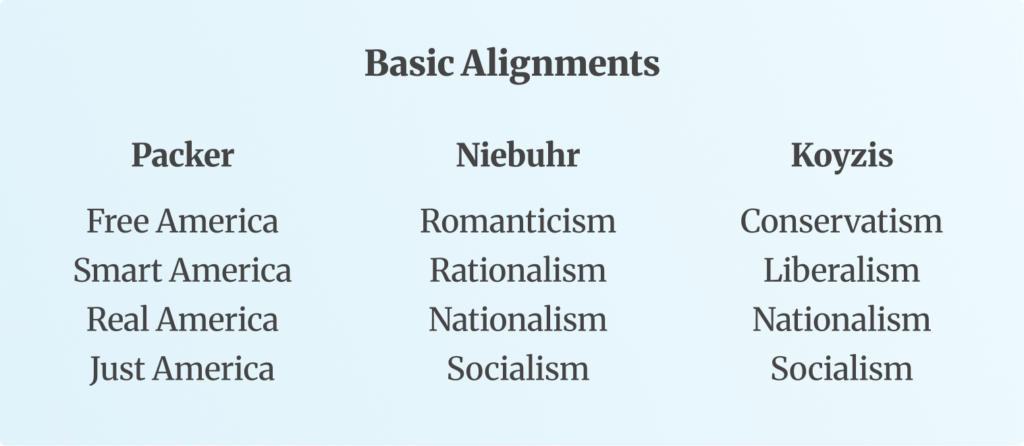
Over eight decades ago Reinhold Niebuhr addressed an assembly of world church leaders in Oxford, UK. In 1937, as the clouds were darkening before a World War, he outlined four “idols” which were the basis of four political ideologies that were headed for a terrible, bloody conflict. This was later published as “The Christian Church in a Secular Age” and is now found in The Essential Reinhold Niebuhr: Selected Essays and Addresses. [] [3] Reinhold Niebuhr, “The Christian Church in a Secular Age,” in The Essential Reinhold Niebuhr: Selected Essays and Addresses, ed. Robert McAfee Brown (New Haven: Yale University Press, 1986), 79-92. The similarities of Packer’s and Niebuhr’s schemas are remarkable and are instructive if compared. Even more interesting is to cross-reference these two essays with David T. Koyzis’ Political Visions and Illusion: A Survey of and Christian Critique of Contemporary Ideologies [] [4] David T. Koyzis, Political Visions and Illusion: A Survey of and Christian Critique of Contemporary Ideologies (2nd edition, Westmont, IL: IVP Academic, 2019). —which I will do briefly below.
Reinhold Niebuhr’s Four Idolatries
The impossibility of strict, irreligious secularism

Niebuhr begins his talk with an eye-opening claim: “Strictly speaking there is no such thing as secularism. An explicit denial of the sacred always contains some implied affirmation of some [other] holy sphere.” [] [5] Niebuhr,The Essential Reinhold Niebuhr, 79. In other words, because human beings were made for the worship of God, if we aren’t worshipping the true God we must worship something. We will elevate something in our lives or culture to being not merely a good thing but an unquestioned, sacred, all-healing, ultimate thing. [] [6] Compare C.S. Lewis: “The defiance of the good atheist hurled at an apparently ruthless and idiotic cosmos is really an unconscious homage to something in or behind that cosmos which he recognizes as infinitely valuable and authoritative: for if mercy and justice were really only private whims of his own with no objective and impersonal roots, and if he realized this, he could not go on being indignant. The fact that he indites heaven itself for disregarding them means that at some level of his mind he knows they are enthroned in a higher heaven still.”
Niebuhr continues to apply this idea—that everyone necessarily must base their lives on faith in some way of knowing and some standard of value that they cannot prove and so they rely on a religious faith. “Every explanation of the meaning of human existence must avail itself of some principle of explanation which cannot be explained. Every estimate of values involves some criterion of value which cannot be arrived at empirically.” [] [7] Niebuhr, The Essential Reinhold Niebuhr, 79.
Finally he says “Consequently the avowedly secular culture of today turns out upon close examination to be either a pantheistic religion which identifies existence in its totality with holiness, or a rationalistic humanism for which human reason is essentially god, or a vitalistic humanism which worships some unique or particular vital force in the individual or the community as its god, that is, as the object of its unconditioned loyalty.” [] [8] Niebuhr, The Essential Reinhold Niebuhr, 80. He then goes on to identify four “gods” that various contemporary, supposedly secular cultures worship.
1. Romanticism
Romanticism makes an idol out of the individual. This has been called expressive individualism—the idea that the highest good is for us to follow our hearts, express ourselves and fulfill our deepest dreams and longings. Niebuhr says this “worships some unique or particular vital force in the individual …. It is the old religion of self-glorification.”
[]
[9] Niebuhr, The Essential Reinhold Niebuhr, 80.
2. Rationalism
Rationalism makes an idol out of science, technology, and reason. While romanticism thinks the answer to all things is free self-expression, this sees science as our “savior.” “Humanistic rationalism, forgetting that human reason … is a derived, dependent, created reality … believes that its gradual extension is the guarantee of the ultimate destruction of evil in history.”
[]
[10] Niebuhr, The Essential Reinhold Niebuhr, 80-81.
3. Nationalism
Nationalism makes an idol out of one’s race and nation. Niebuhr mentions the slogan of “Blut und Boden,” the Nazi slogan promoting one race (blut: “blood”) and land (boden: “soil”). Fascism idealized rural people as the “real nation” as opposed to the cities filled with foreigners. Niebuhr calls this the “self-glorification of race … and nation” rather than of the individual. [] Niebuhr, The Essential Reinhold Niebuhr, 81.
4. Socialism
Socialism makes an idol out of the State and the perspective and actions of the oppressed (“the proletariat”). Niebuhr writes about “Marxism” that “this very philosophy which [rightly] sees the pretensions of all ‘the wise, the mighty, and the noble’ … [then regards] the life of the proletariat as having some mystic union with the absolute.” [] [12] Niebuhr, The Essential Reinhold Niebuhr, 82. Niebuhr shows his preference for socialism over nationalistic fascism (remember it was 1937) but he rightly adds, “As every culture which is not confronted with the one holy God, the creator, lord, and judge of the world, [Marxism] also ends in the sin of self-glorification.” [] [13] Niebuhr, The Essential Reinhold Niebuhr, 83.
David Koyzis’ Four Ideologies
Ideologies as “redemptive stories”
In his introductory chapter, Koyzis makes the same basic argument as Niebuhr. He speaks about clashes of ideologies in the 20th century. What is an ideology? In common use it means a very strongly held (“dogmatic”) set of ideas. But “ideology” also sounds like idolatry, and Koyzis says, “I view ideologies as modern manifestations of that ancient phenomenon called idolatry, [each with] their own stories of sin and redemption.” [] [14] Koyzis, Political Visions and Illusion, 5. Koyzis’ description of these four political ideologies align well with Niebuhr’s. [] [15] Koyzis names a fifth ideology: “Democratism” of “Majoritarianism.” This is the political outworking of Utilitarianism—”the greatest good for the greatest number.” This ideology makes public/majority opinion the only standard of good—leading, obviously, to the possibility of the abuse of minorities. Koyzis treats this ideology on pages 120-150, and it is important material; but whereas the other four ideologies are relatively discrete and different from the others, Majoritarianism can be combined with and used by any of the others, though it is especially conducive to neo-liberalism.
Neo-Liberals (“The Free Individual”)
“Liberalism” is a society based on individual freedom of choice. The best society is seen not as one united by common religion or cultural values (as in nationalism) but a society united by only one value—the freedom to live as you see fit as long as you don’t harm others. Classic liberalism had become so dominant in the West since the mid-20th century defeats of fascism and communism that it broke into two branches to vie with each other. One is called “conservatism” and one is called “liberalism,” but they are both liberalism in that they assume the primacy of the autonomous self and want a meritocratic society. (See P. Deneen, Why Liberalism Failed.) The two branches:
1. Conservatives
Conservatives make an idol of “the market” and entrepreneurship. They believe strongly that the best society has very free capital markets and free competition with little government regulation and taxes. They believe each individual is wholly responsible for his or her situation—if you are poor in a free country it is your fault. The field: business.
2. Liberals
Liberals make an idol of “science/expertise” and self-expression. They believe all relationships are now transactional, reduced to contracting individuals maximizing their own self-interests—the “triumph of the therapeutic.” They believe also that science and technology is the way to handle all problems. The field: elite cultural institutions
3. Nationalists (“Our People” and “The Nation”)
Both civic and ethnic nations can become invested with too high a status, and this is where idolatry makes an entrance. It begins with “airbrushing” one’s national history. The idol of nationalism always demands that the people give their highest loyalty to their motherland, to “their people.” It means that those deemed “not our people” are ostracized and excluded in one of several ways: elimination (they are driven out), domination (they are allowed to be present but are given fewer rights and may be terrorized), assimilation (they are refused admission to most circles unless they lose their cultural distinctives), or abandonment (their basic needs are willfully ignored).
4. Socialists (“Racial, Gender, Sexual Identity” and “The State”)
Just as liberalism sees our condition as solely due to individual choice, so socialism believes that crime and poverty are not mainly due to choice or individual action. Freedom of choice and speech and thought are ruses by which the powerful keep their power. Today modern progressives believe that gender, race, and sexuality does this as well—so our main identity is not individual but social. Unequal outcomes between groups are never due to internal factors—never the result of the individual effort or group culture. Inequalities are always the result of external, systemic social factors all the way down. The solution is never education, or self-improvement or stronger family life—it is social policy and transfer of power. The only way forward is to discredit beliefs and discourses that accrue power for social groups and, through the State, to re-distribute power.
Problems with each ideology
1. Each of them idolizes something that’s good-but-fallen: for Nationalists it’s the people; for Conservatives it’s the market; for Liberals it’s individual freedom and reason; for Progressives (also referred to as Socialists) it’s racial/gender/sexual identity and the State.
2. Each of them demonizes something that’s good-but-fallen: for Nationalists it’s the other races/cultures; for Conservatives it’s the State and big organizations; for Liberals it’s moral authorities like religion and family; for Progressives it’s the free market of money and ideas.
3. Each of them tends to exclude and marginalize classes of people they see as enemies.
4. Each of them tends to idolize people they see as saviors.
All offer simplistic solutions not only to society but to individuals. All these secular hopes will fail because they don’t fit the complexity of good-but-fallen reality.
5. Each of them fails to see the complexity of evil. The Bible sees the world, the flesh and the devil. Progressives see only the world, systemic evil; Liberals see only the flesh, individual moral evil. Nationalists have some sense of both but only as seen in other cultures. None recognize the demonic aspect of evil in the world. So all offer simplistic solutions not only to society but to individuals. All these secular hopes will fail because they don’t fit the complexity of good-but-fallen reality.
George Packer’s “Four Americas”
1. “Free America”(Center Right)
Most recently this was embodied in Ronald Reagan. The core of its vision for what will bring a good society is individual liberty and a free market. Its ideal is the successful entrepreneur who both expresses him or herself and creates wealth. The political policies: open borders, free trade, libertarian on morality, low taxes, aggressive foreign policy, little support for labor unions or for affirmative action.
2. “Smart America” (Center Left)
Most recently this was embodied in Bill Clinton. The core of its vision for what will bring a good society is science and technology. Its ideal is the highly credentialed expert who operates at the top of elite institutions. The political policies: like Free America it values open borders, free trade, and is libertarian on morality; but it also values more support for unions, affirmative action, regulation of business, higher taxes, and less aggressive foreign policy.
3. “Real America” (Far Right)
Most recently embodied in Donald Trump. The core of its vision for what will bring a good society is the traditional culture of the “common people” and “original settlers” (i.e. descendants of white Europeans). Its ideal is the white, working class religious person, which it sees as being displaced. Political policies: pro-labor, anti-free trade, anti-centralized government, anti-immigration, promote religious morality, anti-affirmative action.
4. “Just America”(Far Left)
Most recently embodied in Bernie Sanders and Alexandria Ocasio-Cortez. The core of its vision for what will bring a good society is political structures that eliminate systemic injustice and redistribute power. Its ideal is the activist working against injustice in a particular realm. Political policies: highly pro-union, pro-affirmative action and other racial justice legislation, and pro-immigration; anti-free trade; anti-religious public expression; suspicious of “free speech.”
Problems with each of the Four Americas
1. Each of them is reductionistic. Each of the movements, while targeting real problems, are reductionistic. Packer says near the end of his essay in The Atlantic:
“All four of the narratives I’ve described … respond to real problems. Each offers a value that the others need and lacks ones that the others have. Free America celebrates the energy of the unencumbered individual. Smart America respects intelligence and welcomes change. Real America commits itself to a place and has a sense of limits. Just America demands a confrontation with what the others want to avoid. They arise from a single society, and even in one as polarized as ours they continually shape, absorb, and morph into one another. … [E]ach narrative [moves] into a cramped and ever more extreme version of itself.”
[]
[16] Packer, “How America Fractured into Four Parts.”

2. Each of them is divisive. In addition, each of the four frameworks fail to produce a true democratic pluralism. Free America and Smart America are “meritocratic” but won’t acknowledge the uneven playing field. Real America and Just America are highly distrustful of the powerful and the elite, but they also tend to be less democratic—and less open to free speech, debate and bipartisan compromise. They see all things in terms of good and evil and show little respect or willingness to talk with those they think are evil. In short, each approach excludes and marginalizes classes of people either economically or politically. Packer also writes in The Atlantic article:
“But their tendency is also to divide us, pitting tribe against tribe. … All four narratives are also driven by a competition for status that generates fierce anxiety and resentment. They all anoint winners and losers. In Free America, the winners are the makers, and the losers are the takers who want to drag the rest down in perpetual dependency on a smothering government. In Smart America, the winners are the credentialed meritocrats, and the losers are the poorly educated who want to resist inevitable progress. In Real America, the winners are the hardworking folk of the white Christian heartland, and the losers are treacherous elites and contaminating others who want to destroy the country. In Just America, the winners are the marginalized groups, and the losers are the dominant groups that want to go on dominating. I don’t much want to live in the republic of any of them.” [] [17] Packer, “How America Fractured into Four Parts.”
3. Each of them is, basically, a “white America.” A case can be made that black, brown, Asian, and other non-European immigrants do not fit these categories well at all. These are all largely white Americas, even the most progressive. All admit that “Just America”—while committed to the good of non-white people—is mainly young, white, college educated people who are far more secular, individualistic, and morally liberal than non-white populations. Let’s call this Hidden America—non-white people who end up having to vote for one of these four parties but who don’t share their moral visions or ideals. They are combinations of more conservative and more liberal views and don’t fit into the four “buckets.” However, it is not wrong to identify and discern these four “Americas” as indeed the dominant movements contending with each other and vying for power. Non-white persons and others who (like Packer) don’t share the particular reductionisms and visions of each, need to be able to see them and compare them.
4. None of them fits in with the full range of biblical ethics. Detached from one another and standing alone in a secular worldview “justice/equity,” “freedom,” “pride in one’s nation,” and “personal responsibility/choice” all look somewhat different than they do integrated in a triune, God-centered worldview. In other words, we cannot take each “America’s” main value as that political movement defines it and simply combine them. When they are held together in close connection to each other, and defined by biblical themes, and seen as natural outgrowths of a world created by God—then they are each transformed. Because the Bible not only combines but transforms, you can’t say the biblical position is some kind of single point on any of the political spectrums.
In general, the Catholic Social Teaching and the consensus teaching of the American Black Church do good jobs of this combination of transformed concepts. CST and the consensus teaching of the American Black church do not fit well into any of the “Four Americas” frameworks. White Protestants have much to learn from these bodies of teaching, but I believe white Protestants have things to contribute as well.
Note from Kathy Keller
In reviewing works by Packer and Niebuhr, Tim uses Part 1 of this article to identify four main categories for political ideology and the potential idolatry that can result from them. In Part 2 of his article (which we will publish in our next issue, this summer), Tim concludes his article by laying out some of the lessons we can learn from looking at these ideologies and recommends some actions that can be useful for Christians to remain faithful to the gospel as we navigate the political landscape in America.