You can learn more about Redeemer City to City’s mission and work to grow gospel movements in cities all over the world through church planting by visiting their website or by signing up to receive their email updates.
Twenty-eight church planters, four countries, and one singular focus: the gospel.
When this group landed in Nairobi, Kenya, on February 2 for City to City Africa’s English-speaking church planting Intensive, they represented two distinct phases of church planting. Some were a year out from launch and meeting with a core team, while others had already launched their Sunday services. CTC Africa’s approach is unique from other regions because they intentionally include planters who are one to two years post-launch. CTC Africa has found this to be an effective strategy in reaching more church planters, as it captures a critical window where a leader can still adjust their strategy and immediately apply what they learn during the Intensive.
Together, these 28 church planters received training grounded in and centered on the gospel. They were challenged to preach Christ through the whole Bible because it all points to him. They became reacquainted with their Heavenly Father, who loves them and redeemed them at a great cost. Each of these leaders is now participating in a year-long residency program to deepen their learnings from the Intensive, strengthen their relationships with their fellow planters, and expand the influence of gospel-centered churches in their cities.
These church planters are from:
Accra, Ghana
- Anthony Larbi, Bernard Twumasi, Festus Addo, George Fiamawle, Hayford Offei, and Prince Nortey
Nairobi, Kenya
- Dan Gachuki Nduta, Jude Muchiri Karanja, Patrick Cyprian Bundi, Peter Mukungi, and Stanley Wandeto Ngari
Johannesburg, South Africa
- Blaque Nubon, Bongani Cekiso, Cliford Mthombeni, David Kobedi, Gift Maseko, Itu Mamasedi, Jeffras Mphuthi, and Sihle Ndumela
Midrand, South Africa
- Kennedy Mahoko
Pretoria, South Africa
- Johan du Toit
Kampala, Uganda
- Fred Rubagumya, Ivan Kakumirizi, Jacob Mayamaba, Lauben Ataho, Robert Kalenzi, and Ronald Amanya
Jinja, Uganda
- Roy Kasika
City to City gives thanks to God for the many gifts provided this past GivingTuesday through the generosity of Gospel in Life’s supporters. These gifts directly supported the February cohort and will also fund a second cohort of 20 church planters attending the next training intensive in Nairobi from June 4 to June 12, 2026.
It’s a testimony to the belief that the gospel truly changes everything, everywhere.
Through the support of Gospel in Life’s audience, City to City is seeing firsthand how the equipping of these church planters is a catalyst for gospel change in more lives all across Africa. It’s a testimony to the belief that the gospel truly changes everything, everywhere. City to City asks for continued prayers that the 28 leaders from the February cohort and the 20 scheduled for June will see God work in new ways in each of their cities.
Here is one story from Yomi Ojute, a leader who attended the Intensive just one year ago. It beautifully demonstrates how God is working through his church in the Yaba neighborhood of Ikoyi, Lagos.
Yomi’s story of gospel change
Like the leaders listed above, Yomi Ojute found himself on a similar list when he attended the Intensive last year. Yet Yomi was a long way from his original plans to start a ministry abroad in Canada.
Yomi met his future wife, Oreoluwa, at university. They had a clear plan for their lives: graduate, get married, get jobs, raise money, and “japa” to Canada. For many young Nigerians “japa,” leaving the country for better opportunities abroad, is a common dream.
However, in the middle of their plans, Yomi came to Oreoluwa with unexpected news: “God is saying we need to plant a church here.”
So they stayed.
At the time, Yomi was serving as an associate pastor at a 20-year-old church in Ikoyi, Lagos. As he continued in ministry, Yomi sought ways to serve his neighborhood, Yaba. When Yomi’s friends encouraged him to run for a local political position, he thought, “Yes! This is what God is calling me to do: to be a voice of change in my local community.” In many ways Yomi was the perfect person for the job. He was already trying to solve real problems by raising money for street lights and campaigning for better roads. He had lived in Yaba since he was two years old: “My primary school is in Yaba, my secondary school is in Yaba. My first university degree is in Yaba. My master’s degree is in Yaba. So literally, I’ve lived my life in Yaba.”
Yomi describes Yaba as a hub of technology, educational institutions, and young families. Numerous tech start-ups call Yaba home, giving it its nickname, “Yabacon Valley,” the Silicon Valley of Nigeria. With institutions like the University of Lagos and Yaba College of Technology, and with Nigeria’s median age around 18–19 years old, Yaba is at the epicenter for ideas and culture. Yet spiritually, Yomi believes the neighborhood faces a different challenge: a disparity between what people profess as Christians and how they actually live. “There’s a far cry between our confession and our sanctification,” he said.
As the election approached, Yomi believed God was confirming the path. “While we were praying about the election, God was sharing dreams with me,” he said. “I thought I was going to solve problems, heal the sick, and open doors for the gospel in my community.”
But Yomi lost the election.
“I failed,” he said.
Yomi was shocked and confused.
Months later, Yomi began to understand that God wasn’t calling him to meet political needs. God was calling him to meet spiritual needs. For a while, Yomi wrestled with what the loss meant. Though he continued as a pastor in Ikoyi, Yomi and Oreoluwa sensed God calling them to plant a different type of church. Yomi eventually stepped down from the church and he and Oreoluwa planned to take a break. In a few years, they would re-evaluate if church planting was still on their horizon.
God wasn’t calling him to meet political needs. God was calling him to meet spiritual needs.
But God had other plans. Yomi met Pastor Femi Osunnuyi of City Church Lagos, who began encouraging and mentoring him, affirming the calling he saw in Yomi’s life. Rather than planning for a break, the Ojutes began praying about planting a church. One question kept surfacing: where?
Yomi and Oreoluwa realized that if they truly wanted to plant a church, they had to let go of their plans to “japa,” otherwise the church plant would not work. They were committed to staying rooted in a community. As they prayed, they both kept sensing the same place: Akoka, a suburb of the Yaba area where Yomi had grown up.
Despite his deep connection to the neighborhood, Yomi wasn’t sure people would take him seriously as a pastor. Much like Jesus, who couldn’t get through to his community in Nazareth (Mark 6:4), Yomi wondered if the people who knew his past would listen to him. “People knew me when I used to walk around, when I used to follow girls, when I used to party and organize parties,” he said. “They also know that I was transformed because I became a believer.”
He also worried about how people in his old neighborhood might interpret the decision. “I didn’t want people to think that because I failed in politics I was now becoming a pastor,” he said. The loss also made him hesitant about taking another public risk. But for Yomi, planting a church wasn’t a fallback plan; it was a calling.
With Pastor Femi’s encouragement, Yomi and Oreoluwa started their church plant as a Bible study with five to six people in Akoka. One day, while they were evangelizing in the neighborhood, Yomi and a friend approached the owner of the local “Mr. Biggs,” a popular fast-food chain. They boldly asked if they could meet in a corner of the restaurant once a week. The owner agreed, telling them they could start the next day. For one year, Yomi met with the beginnings of a core group for his future church plant. “The idea of the Bible study was to teach,” said Yomi, “but we were also trying to ensure that we had people who were committed.”
Sensing Yomi could benefit from training on how to build and plant a church, Pastor Femi, a 2015 City to City International Intensive alum, recommended Yomi apply for the 2025 Intensive in Nairobi. Unlike a decade ago, the training was now held locally, facilitated by an all-African team with curriculum specific to the African context.
Yomi was accepted and he experienced gospel renewal on a deep personal level.
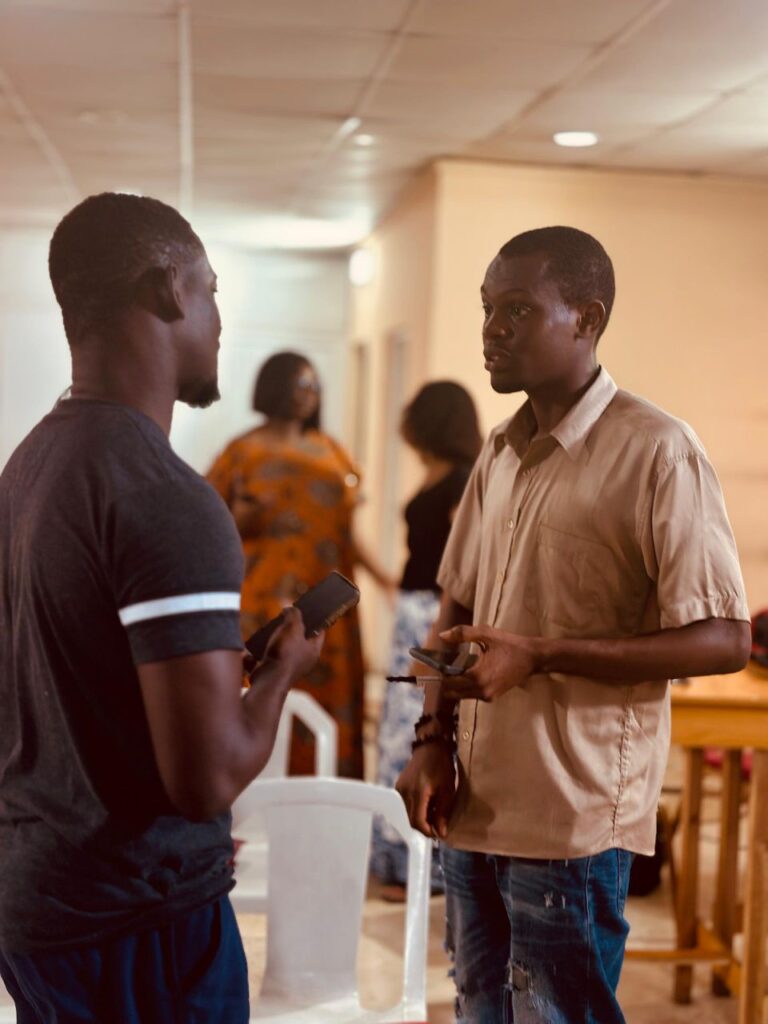
During the training, Yomi heard trainers remind him and the other 20 church planters in attendance that, even as pastors and church planters, they need to be objects of gospel renewal before they are agents of gospel renewal.
“My greatest lesson is learning that I’m a son of God,” Yomi shared. “Especially for someone like me who has never had a father figure. My father left my mom before I was two. I’ve had to struggle with the idea of God being my father, but today I recognize and I believe through the Holy Spirit I can understand that God is truly my father.”
This realization transformed the way he thought about himself, not just as a planter, but as a human being. “It deepened my understanding of how I need to trust in God, to trust in the power of the gospel—for myself, and for the ministry that God has put in my hands.”
The gospel helped Yomi see that his identity was not rooted in political success or ministry achievement, but in being loved by God. That shift reshaped how Yomi approached planting his church in Lagos. Rather than building a church around personality or programs, he focused on creating a community centered on the clear teaching of Scripture and the transforming power of the gospel.
And God has done a great work. After a year of meeting at “Mr. Biggs,” City Church helped Yomi secure a hall to expand. Another church that met in the same hall offered their equipment as well, a generosity Yomi saw as confirmation of God’s provision. With more room to grow, Yomi began thinking more intentionally about reaching young professionals.
“Last year,” Yomi says, “I did something that I couldn’t believe I could do.” He reached out to colleagues from his fintech job and professional network—anyone with whom he had a relationship—inviting them to an Easter service. Twenty-six people showed up. One of them, named Feyi, immediately became a member. She had been a Christian but had only been watching livestreams. Feyi felt God wanted her to stay committed and be a part of the church.
Yomi and Oreoluwa began inviting people over to their house for lunch. They would eat Oreoluwa’s delicious jollof rice and Yomi would share the vision God had put on their hearts. Soon, the church was 85% young professionals. On Sunday, March 1, Watergate Community Church held its official launch.
Yomi says the inspiration for the name Watergate is from Nehemiah 8 where the people, in an assembly at the Water Gate, “understood the Word, and as they understood the Word, they experienced renewal as individuals.” The passage demonstrates Yomi’s vision for the church and the city. He believes this roadmap will lead to a gospel movement on a national scale: “Once the gospel is clearly taught and faithfully received, it will lead to the renewal of people who form godly communities and transform society.”
In a culture where the “Founder” of a church is often at its center, Yomi is practicing something countercultural, where the gospel is the center. “It’s not my church,” he says. “That allows me to rest more. To trust the power of the gospel to sustain the work.” This posture of grace is modeled in his leadership. When Feyi missed a service for a family function, she was afraid that as the pastor, Yomi would be upset, but he surprised her by affirming that a family function is a good excuse because God created her family and wants her to be with them. “Wow, this is different,” she said. As a bi-vocational leader, Yomi knows the challenges his congregation faces because he faces them too. Demonstrating that the church is not about him and his work, Yomi intends to step back from his church responsibilities for a few weeks when his baby is born.
Yomi is clear on what God has called him to do: “Ensure that the gospel is at the center of everything we are doing.” And he is seeing the signs of gospel transformation in many of his congregants. “At Watergate, we are on mission to disciple people to live like Christ.”
Please pray for Yomi and his church
- Pray that God would provide partners who will support the work now and for the long term.
- Pray for Yomi and Oreoluwa as they prepare for their new baby, and that they would find balance between their work for the church and raising their family.
- Pray that God would work through Watergate to bring gospel renewal to Yaba, and that God would strengthen the congregation to live out and invite others into Watergate’s vision.